







Could you tell us about your area of expertise?
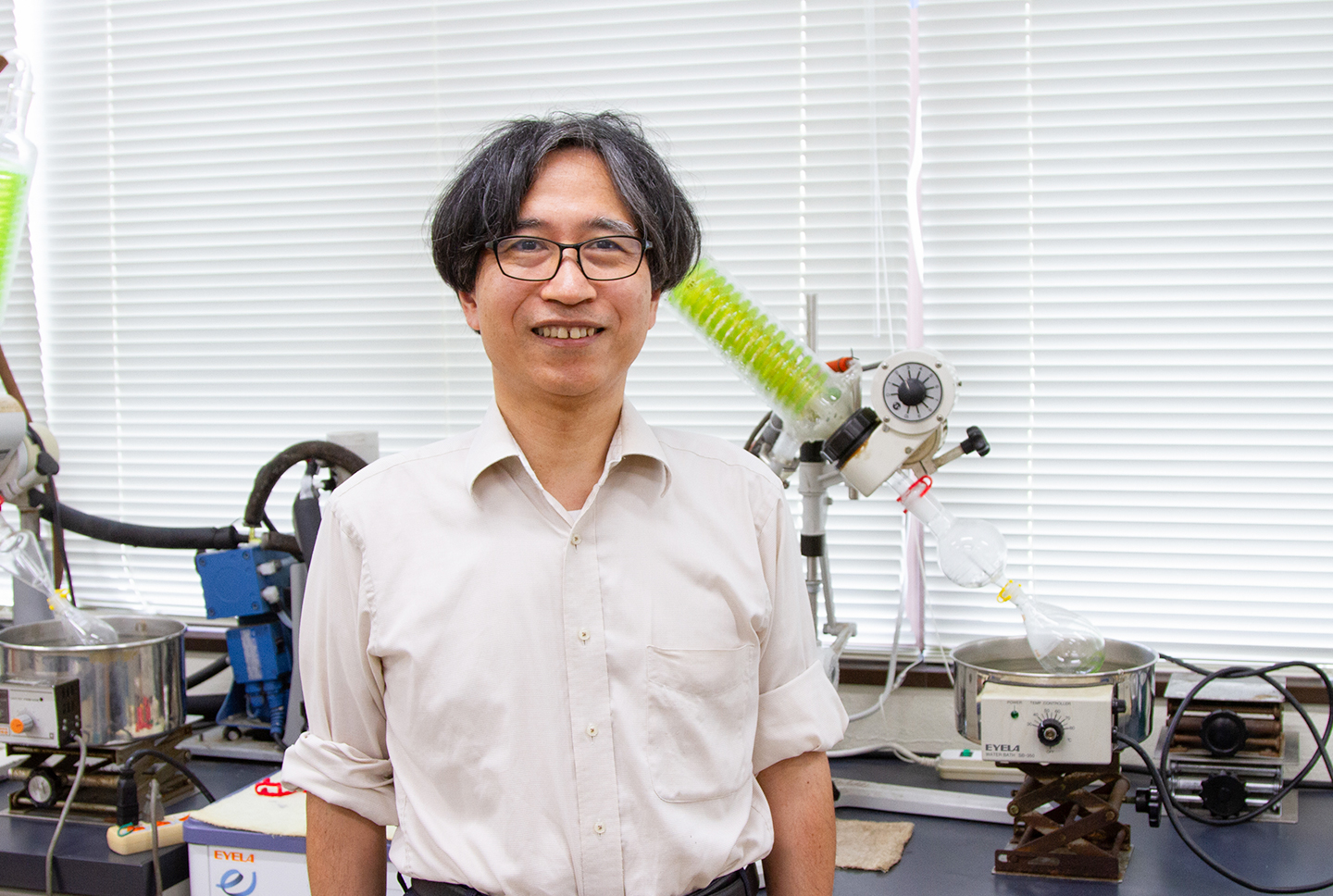
My laboratory is the Laboratory of Bioregulation Chemistry, where we specialize in bioorganic chemistry and natural products chemistry. Historically, this area of research might have been described as pesticide science. Rather than studying synthetic pesticides created by humans, however, we investigate at the molecular level the compounds that plants themselves produce to defend against pathogens and other external threats.
Unlike animals, which rely on immune systems involving antibodies and white blood cells, plants respond to stress by rapidly producing compounds that function as their own pesticides. These antimicrobial compounds are known as phytoalexins. Our research focuses primarily on phytoalexins produced by rice, with the aim of elucidating how they are produced and how they function.
What inspired you to pursue this line of research?
My interest began when I first started thinking seriously about my future in junior high school. Based on my interests and strengths, I decided to pursue the sciences. But science offered many possible paths, including pure science, engineering, medicine, and agriculture, so I asked myself, “Which field is most essential to society?”
Saving lives through medicine is admirable, and developing useful technologies through engineering is also important. Yet no matter how far medicine or technology advances, people cannot survive without food. Even as a junior high school student, I recognized the fundamental importance of agriculture, which led me to enroll in the College of Agriculture at Ibaraki University.
When it came time to choose a laboratory, I wanted to pursue research directly connected to agricultural production within the field then known as agricultural chemistry. That choice brought me to the laboratory where I have continued my research ever since.
Research on rice phytoalexins at the College of Agriculture, Ibaraki University, dates back to the 1980s. I inherited this line of research from my mentors and have continued to develop it.
What do you find most rewarding about your research?
One of the greatest rewards of natural products chemistry is the possibility of discovering entirely new compounds that have never before been identified.
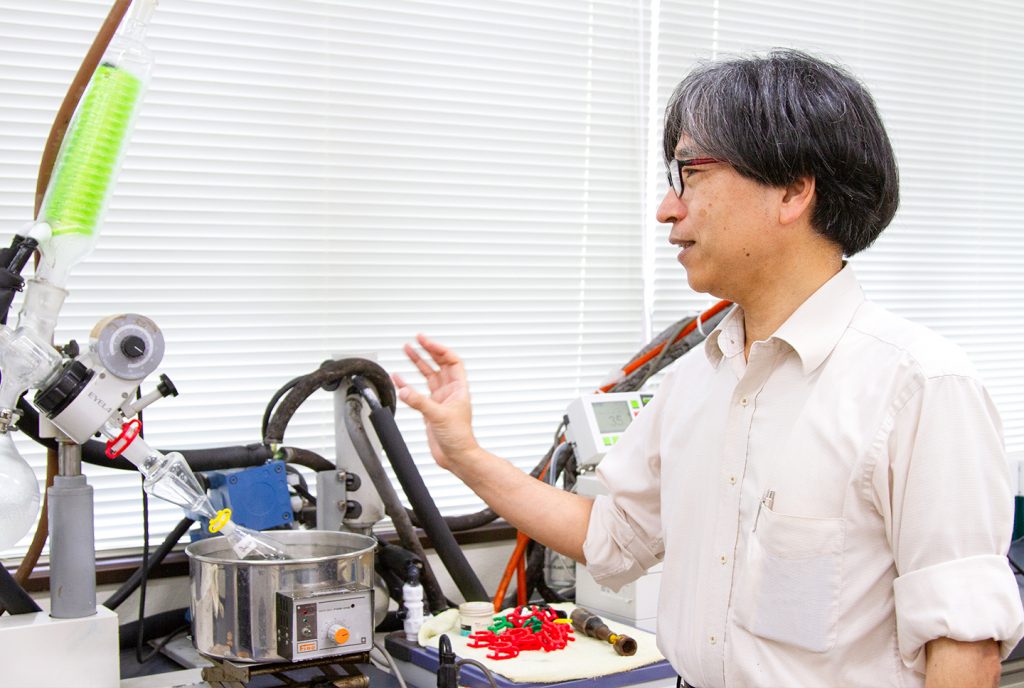
In practical terms, we use instruments such as nuclear magnetic resonance (NMR) spectrometers, which employ superconducting magnets to generate powerful magnetic fields. By analyzing the resulting data, we determine how carbon and hydrogen atoms are connected and assemble the chemical structure piece by piece, much like solving a puzzle.
A newly discovered compound may not lead immediately to a drug or other practical application. Even so, expanding humanity’s body of chemical knowledge is valuable in its own right. Any one of these compounds may eventually prove to have an unexpected function that contributes to human well-being.
Perhaps 99 percent of research does not yield the results we hope for. Yet the remaining one percent provides a sense of excitement and discovery that can only be experienced through research.
How does your work relate to other research at Gtech?
One of Gtech’s main research areas is the use of microorganisms to reduce greenhouse gas emissions while promoting crop growth. My own research does not, of course, offer a direct solution to climate change.
Plants release a variety of compounds from their roots. These compounds do more than repel pathogens: plants also use them to shape the surrounding microbial community and attract microorganisms that are beneficial to them.
Working with researchers who specialize in microorganisms, we investigate at the molecular level how the compounds produced by plants change when microbial-based agricultural products are applied.
Climate change may also bring plant diseases unlike those we have encountered in the past. In that context, our fundamental knowledge of the diverse compounds plants use to defend themselves against pathogens should prove valuable. This work may contribute to breeding more disease-resistant crops and developing new agrochemicals that strengthen plants’ natural defense systems.
What are your goals for this research?
Rice is known to produce more than 30 phytoalexins. My goal is to explain, at the chemical level, why rice produces such a diverse array of these compounds and how they function in the ongoing struggle between plants and pathogens.
We are also studying phytoalexins in wild rice species that are not cultivated for food. This allows us to trace how these compounds evolved. In the future, genes from wild rice might be used to enable cultivated rice to produce new types of phytoalexins.
However, even if this research were to produce exceptionally disease-resistant rice, that alone would not immediately solve the world’s food problems. At times, I think systems for distributing food may be even more important than producing it.
Researchers can easily become too narrowly focused on their own specialized fields. I therefore want to maintain a broad perspective while steadily pursuing the questions within my own area of expertise.
What do you hope Gtech will achieve in the future?
The environment for fundamental research is becoming more challenging each year. Funding constraints and staff shortages are reducing research capacity and output. Yet we cannot simply accept a decline in what we accomplish.
As it becomes increasingly difficult for a single laboratory to sustain its research independently, I hope the Gtech framework will help us expand collaboration with researchers in other fields.
Collaboration within Gtech also allows us to approach questions from new perspectives, often in response to ideas or requests from other researchers. This can lead to discoveries we would never have considered within the confines of our conventional research. Those unexpected findings can then feed back into and advance our own work. I hope Gtech will foster this kind of virtuous cycle.
A message to students
I believe a laboratory is a place where students can truly grow only by engaging seriously with a problem.
If your sole goal is to earn a university degree, you may be able to complete a graduation thesis with minimal effort and still graduate. Genuine research, however, begins when you confront a problem with the intention of growing through the process.
The specialized knowledge you gain may not always be directly applicable later in life. The problem-solving and communication skills you develop through sustained, rigorous research, however, will undoubtedly serve you well in your career.
University research offers moments of excitement that cannot be experienced anywhere else. I hope you will make the most of your limited time as a student and discover for yourself what makes research so fascinating.