







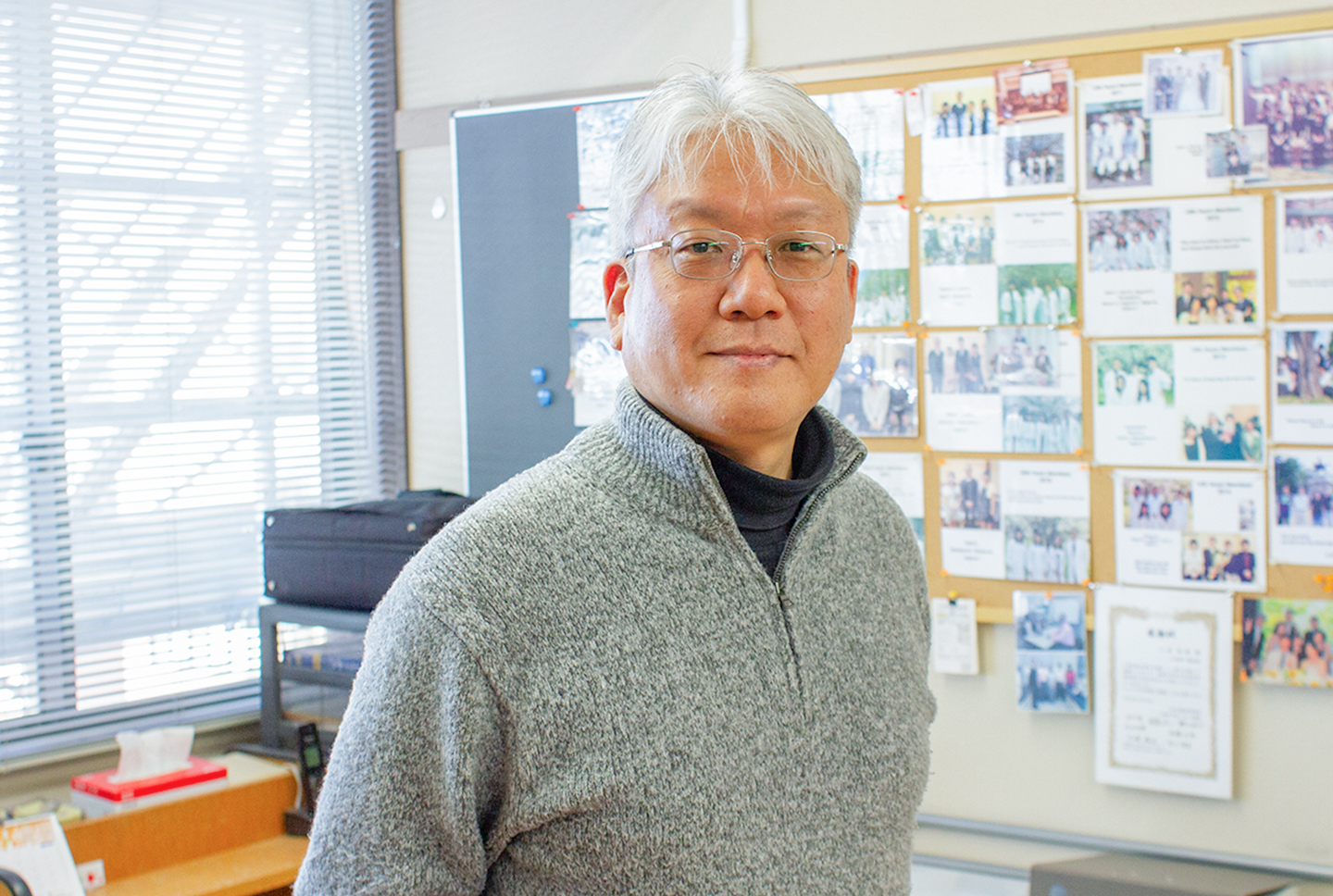
Please tell us about your field of expertise.
My field is plant physiology and molecular biology. I study biological processes at the molecular level to understand how interactions between molecules influence how plants function.
Plants cannot move away from stressful environments. Even so, they survive under very harsh conditions. I study what happens inside plant cells at the molecular level to understand the survival strategies that make this possible.
In particular, I focus on how plants respond to salt stress. Soil salinity affects about 10% of the world’s lands, which makes it difficult for plants to grow. My goal is to promote sustainable agriculture by developing plants that can withstand salt stress and restore damaged ecosystems.
What inspired you to pursue this field?
My interest began in high school, when I became curious about a simple question: How can genes—just molecules—create living systems?
At first, I was interested in animal immunity. However, when laboratory assignments were decided at university, I lost a game of rock–paper–scissors and joined a microbiology lab, where I started working on plants (laughs).
As I studied plants, I became fascinated by how they respond to environmental changes even though they cannot move. I realized that because they are immobile, they must have developed very sophisticated strategies to survive.
I wanted to understand how these strategies work at the molecular level and how everything is connected. That curiosity led me to research in which I try to “listen” to the voices of plants through molecular analysis.
What do you find rewarding about your work?
When I start with a simple “why” from everyday life and examine it closely, I often find a world that is complex yet beautifully organized.
The molecular processes that enable plants to change their shape in response to their environment reveal systems that have evolved over long periods of time.
Designing my experiments and uncovering even a small part of these systems is always exciting. When I begin to understand what a plant is “thinking,” another question naturally arises: “What happens next?” This ongoing curiosity is what makes research enjoyable for me.
What is appealing about Gtech?
One of the most attractive aspects of Gtech is the opportunity for collaboration. By working with researchers from different fields, we gain a broader perspective and can see things that would otherwise remain invisible.
At Gtech, I am involved in research on soybean-soil microbial symbiosis to reduce greenhouse gas emissions. My role is to study what is happening inside the plant at a very small scale—almost like trying to understand the plant’s “feelings.”
Meanwhile, other researchers provide insights into what is happening in the soil and how greenhouse gases are changing. Understanding what occurs outside the plant helps me better grasp what the plant may be experiencing inside.
These interdisciplinary discussions help us interpret plant responses more accurately, and I learn a great deal from them.
What goals or mission do you have in this research?
My goal is to become an interpreter of plants.
Increasing food production and reducing greenhouse gas emissions are important societal goals. However, we also need to understand how plants themselves respond to these demands. If we push them too hard, they may experience stress.
By studying what happens inside plant cells, I hope to convey messages such as, “This is how soybeans are responding right now,” or “This is what they actually need.”
Ideally, human goals and the needs of plants will align, creating outcomes that benefit both.
What do you hope for from Gtech in the future?
I would like to translate complex laboratory data into language that farmers and the public can easily understand.
For example, we could say, “Because the plant is responding this way, this material may be helpful,” or “Using this microorganism may support soybean growth.” In this way, we can express the needs of plants, even though they cannot speak, in everyday language.
I hope this will lead to cultivation methods that maximize the potential of plants and help solve global challenges, such as reducing greenhouse gases and ensuring food security.
A message for those interested in Gtech
Addressing global challenges such as climate change requires the interest and involvement of society as a whole, including researchers.
At Ibaraki University, researchers from many different fields are working to address these issues in various ways. Please visit our website or attend our open campus events to learn more about our work.
We welcome insightful questions from high school students and parents alike.
A message for students
Please do not ignore the small “why?” questions you encounter in daily life. Try looking at them through the lens of science.
For example, plant roots grow downward because the root tip contains tiny starch-containing particles that act as gravity sensors, enabling cells to detect the direction of gravity.
Even simple plant responses are supported by surprisingly sophisticated mechanisms. I hope you will experience the excitement of discovering how amazing plants truly are and the joy of exploring scientific mysteries.
Rather than feeling distant from science, I encourage you to stay curious and explore new worlds through research.