






Please tell us about your field of expertise.
My field of research focuses on agricultural practices — specifically, how to achieve optimal agricultural production by making the best use of the resources available in a given environment.
To be more specific, I study how different farming methods—such as whether or not to till the soil, or how to arrange crop rotations—affect productivity and environmental conditions when applied in actual paddy fields and upland.
Our experiments are conducted not only on university farm but also in collaboration with local farmers. When new agricultural techniques are developed, we work together to verify their effectiveness in real farming settings.
What inspired you to begin research in this field?
When I was in junior high school, I studied environmental pollution, including the Minamata disease, in my social studies classes. During that time, I read various books, including those on agriculture. One book that left a particularly strong impression on me was The One-Straw Revolution by Masanobu Fukuoka, which describes his philosophy of natural farming.
Through his work, I learned that while humans can have negative impacts on the environment, it is also possible to restore ecosystems and cultivate crops through the power of nature. That idea inspired me to pursue environmental issues, which ultimately led me to study agriculture at Ibaraki University.
I was also fascinated by the role of food production systems in civilization—how soil degradation contributed to the fall of the Roman Empire, and how the foundation of a civilization is built not on oil, but on food. Coming from a part-time farming family, I was naturally inclined to think deeply about the meaning and value of agriculture.

What is your current research theme?
I aim to further explore the idea that agriculture can actually conserve the environment.
For example, in soybean cultivation, we have shown that regenerative practices such as no-tillage farming, cover cropping, and the use of biochar (such as rice-husk charcoal) can transform farmland into a sink for greenhouse gases rather than a source.
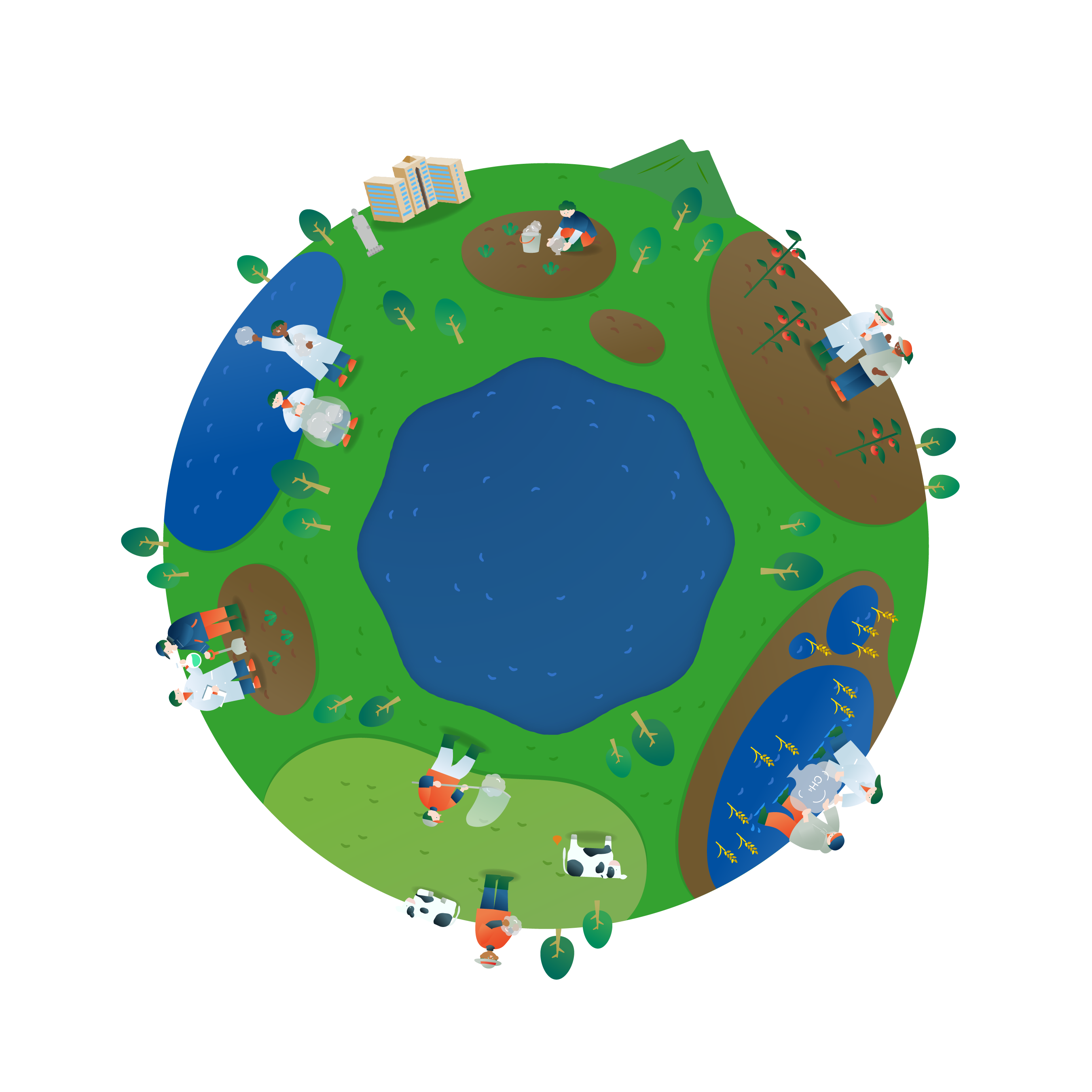
We are also conducting similar studies in rice paddies, wheat fields, organic vegetable fields, and vineyards—adapting new cultivation methods for each crop.
In every case, our goal is to identify farming systems that promote ecosystem restoration and environmental conservation through agricultural activity itself.
What do you find most fascinating or rewarding about your research?
My goal is to improve soil health through agriculture. However, changing the soil is not an easy task—it takes a very long time.
We have maintained a long-term experimental field since 2002. For the first three years, there was almost no visible change, and it felt like no progress was being made. Yet, with persistence, the soil eventually began to change.
We can observe transformations in microbial layers, biological communities including earthworms, and the overall productivity of plants. Nature responds to human intervention, and being able to capture those responses as data—that is the truly fascinating aspect of this research.
How does your research connect with other studies at Gtech?
Gtech consists of three research units, and I have already begun collaborative projects with faculty members in each of them.
In the Agriculture and Ecosystem Conservation Unit, we are conducting studies on the management of agricultural ecosystems, focusing on aspects such as soil carbon sequestration and crop productivity.
With colleagues in the Microbial Genetic Information Analysis Unit, we are examining how microbial species and communities change specifically when new crops are planted or residues are incorporated under cover cropping and no-tillage practices.
With researchers in the Integration and Technical Cooperation Unit, we are working on calculations such as life cycle assessment (LCA) analyses of no-tillage farming—quantifying how much carbon is emitted through agricultural production activities, and evaluating the environmental impact of improved cultivation methods. Through these studies, we aim to explore practical approaches to improving soil health while maintaining agricultural productivity. Even within the same unit, each professor contributes from a unique area of expertise—ranging from data science to nitrogen cycling—bringing diverse perspectives to our collaborative research.

Could you tell us about the history of environmental research at Ibaraki University?
Ibaraki University has a pioneering history of linking agriculture with environmental issues—dating back to the 1970s.
At that time, water pollution was thought to originate mainly from household or industrial wastewater, or livestock operations. The idea that agriculture could harm the environment was almost unthinkable.
However, researchers at Ibaraki University were among the first to point out that nitrogen runoff and leaching from farmland was a serious problem. This insight was rooted in studies of Lake Kasumigaura, a shallow lake surrounded by farmland, which made it highly sensitive to agricultural impacts.
Because of this local context, Ibaraki University developed an early and enduring commitment to studying the conflicts between agriculture and the environment.
What are your goals and mission at Gtech?
Modern agriculture depends heavily on petroleum-based energy—for fertilizers, pesticides, and machinery.
If we truly want to mitigate climate change, we must seek ways to reduce our reliance on fossil fuels. That leads us to focus on maximizing the natural capabilities of ecosystems themselves.
Cover crops are one example, but Japan still has many untapped “green resources.” By utilizing these resources wisely, we aim to develop farming systems that sustain and enhance productivity while reducing environmental impacts.
As our research progresses in Japan, we also hope to expand our efforts internationally—to explore whether these technologies can be adapted for use in other countries.
Do you have a message for students?
Research at Gtech covers a remarkably wide range of topics and approaches.
This means our methods are diverse and require interdisciplinary collaboration and data integration across teams. Some people may think agricultural research is just about growing crops—but in fact, it draws upon knowledge from environmental science, ecology, economics, and sociology.
It may sound like a grand challenge, but agriculture is directly connected to our everyday lives. I hope students will join us in exploring what kinds of agriculture can help create a more sustainable and fulfilling society.