





Please tell us about your field of expertise.
My specialty is horticulture, which deals with the study of fruits and vegetables. My research is broadly divided into two areas:
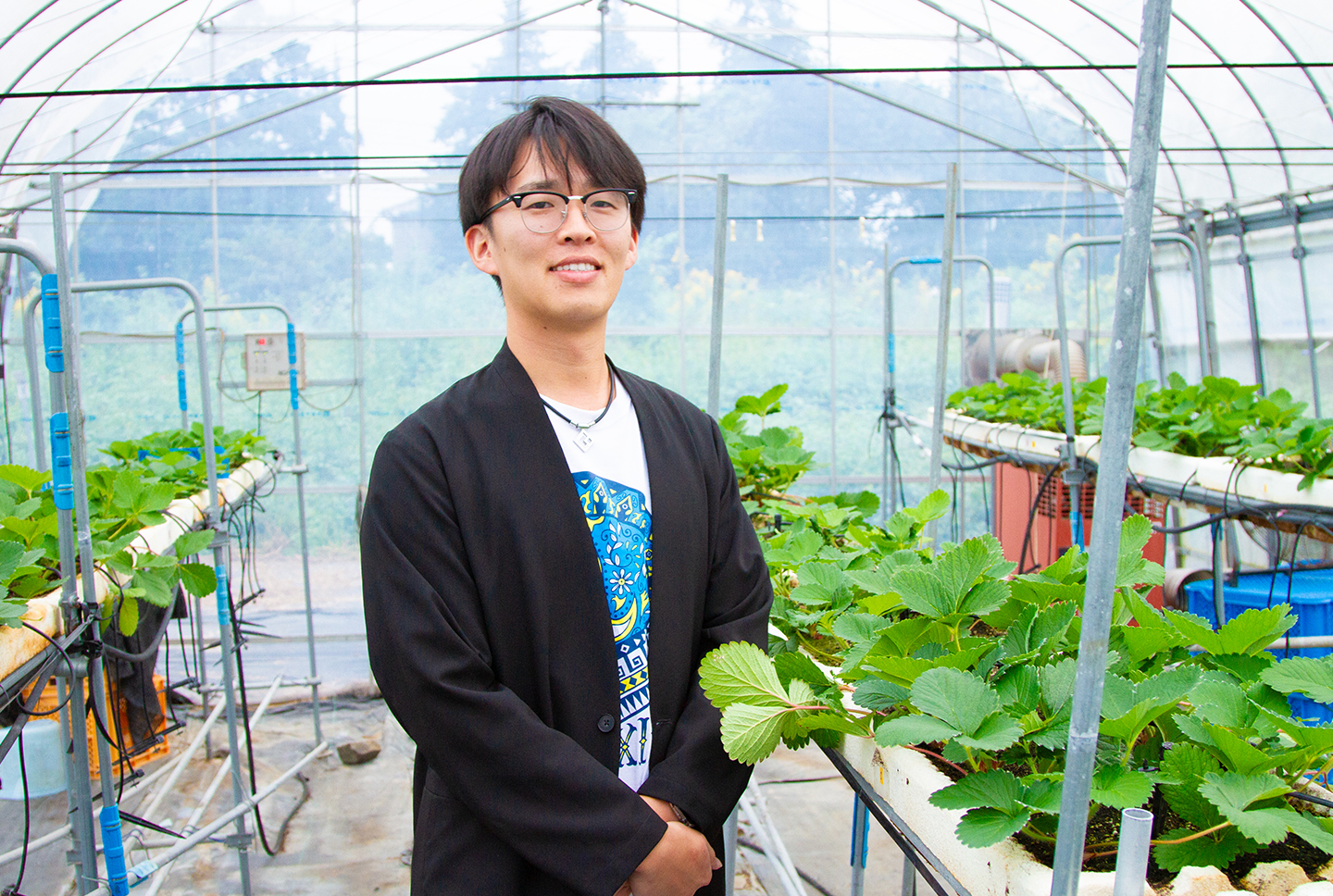
The first is the production of horticultural crops. I primarily work with strawberries, studying cultivation techniques and management practices to increase yield, while tailoring methods to the unique characteristics of each cultivar.
The second is the postharvest physiology, where I work to develop technologies that extend the shelf life of fresh produce. In recent years, Japan’s agricultural exports—not limited to horticultural crops—have increased rapidly. Strawberry exports have increased by nearly tenfold over the past few years.
To support this growth, I am conducting joint research with partners such as the Tokyo Metropolitan Government, aiming to improve storage technologies for strawberries and blueberries using high-performance packaging films and sterilization treatments.
What inspired you to pursue this research?
The inspiration came from my grandparents, who were strawberry farmers. Growing up near my home in Shizuoka, I observed strawberry production closely from an early age. I initially entered the Faculty of Agriculture with the intention of taking over the family farm. Although I was ultimately unable to inherit the farm, I earned my doctorate under Professor Isao Ogiwara (Professor Emeritus, Tokyo University of Agriculture and Technology) and decided to continue my research on horticultural production, especially strawberries and tomatoes.
Currently, I cultivate approximately 15 strawberry cultivars in university greenhouses as part of my research. Many universities study strawberry cultivation, but because my roots are in a farming family, I have a strong desire to excel in this field and produce results that reflect that background.
What do you find rewarding about your work?
Cultivating plants does not simply produce results just by growing them. I often compare plants to people: when you invest time and care into them, they always respond positively. But if you neglect them, they can “get into a bad mood.”
By understanding this and interacting with the plants, you begin to learn how to adapt their management practices—for example, what measures work best for heat-tolerant cultivars or for cultivars that are more resistant to cold. Discovering optimal cultivation methods through this kind of dialogue-like interactions is one of the most enjoyable aspects of my work.
What is your research theme at Gtech?
The strawberries and tomatoes I work with are mainly grown in greenhouses. Unlike crops grown in open fields, greenhouse horticulture typically uses nutrient solution culture, in which fertilizers dissolved in water are continuously supplied to the plants. Approximately 30% of the supplied solution was intentionally allowed to drain, as this is believed to promote better growth and higher yields. The nutrients that flow out contribute to environmental burden. In this sense, greenhouse horticulture—which can be viewed as “cultivation that negatively impacts the environment”—stands in contrast to Gtech’s mission.
However, few researchers have focused on environmental sustainability in greenhouse systems; therefore, I see great potential in this area. My goal is not only to grow delicious horticultural crops and increase yields but also to develop greenhouse cultivation methods that consider their environmental impact.
For example, if we can identify which cultivation practices cause increased N₂O emissions, we can clearly communicate to farmers what practices should be avoided. I hope to clarify such knowledge and turn it into practical guidance.
How does your work connect with other research within Gtech?
While I have strong expertise in horticultural crop production, my work on environmental sustainability is still in its early stages, and I am currently learning how to measure N₂O emissions from scratch. At Gtech, we have specialists in plant science, agricultural machinery, and even researchers who measure plant structure in 3D. By collaborating with these colleagues, we can determine the optimal amount of fertilizer, the minimum energy required, and other key factors. Reducing unnecessary inputs can significantly lower greenhouse gas emissions.
By combining expertise across disciplines, I hope to identify and optimize cultivation techniques that reduce environmental impacts.
What goals or mission do you have for this research?
I believe that the goals set by Gtech are essential for the future of agriculture. I also want to develop environmentally friendly horticultural techniques. To do this, I plan to work with students to clarify cultivation methods and cultivar traits that contribute to greenhouse gas reduction, and incorporate these findings into education.
As the only member specializing in horticulture at Gtech, I feel both the expectations and the responsibility to build this research area from the ground up. I hope to generate ideas that draw on my strengths and develop new research directions. Ultimately, I want Ibaraki University to play a leading role in addressing global environmental challenges.
A message for students
I encourage you to take an interest in vegetables and fruits. When you actually experience growing them yourself, you begin to understand how they are produced, how much effort farmers invest, and how fertilizers are used. This awareness is also important for thinking about environmental issues.
If you love vegetables and fruits, I would be delighted to explore this research together with you.